


In German-language AI search, ChatGPT runs about 1.4 searches per answer and almost never repeats them: on 96.8% of consecutive days, a prompt's fan-out queries shared not one identical string.
That matters to anyone who plans content around "the" fan-out queries of a prompt, because in ChatGPT there is no fixed set to plan around. Across about 520,000 tracked answers in 30 days, between 92% and 93% of them to prompts tracked for Germany, Austria and Switzerland (DACH), ChatGPT rewrote the same prompt differently almost every day, kept the vocabulary, and added a year to 31% of its searches and a country to half of them. Claude searched less, wrote shorter queries and repeated itself far more.
Which engines show their fan-out queries
Fan-out is the step where an AI engine turns one prompt into one or more web searches before it writes the answer. We covered the mechanism, Google's documentation and the patents in query fan-out analysis for Google AI Mode. This study is about what the searches look like when you can read them. Rewriting a query before retrieval is an established technique in research on retrieval-augmented models, for example the Rewrite-Retrieve-Read framework by Ma et al. (EMNLP 2023).
Finseo stores the search text only where an engine hands it over. In the 30 days to 14 November 2026 that was true for two engines with enough customer data to report:
| Engine | Answers with recorded searches | What we see |
|---|---|---|
| EngineChatGPT | Answers with recorded searches99.8% | What we seeThe search strings ChatGPT sent, per answer |
| EngineClaude | Answers with recorded searches39.1% | What we seeThe web search tool calls Claude made, per answer |
| EngineGemini, Perplexity, Google AI Mode, AI Overviews, Copilot | Answers with recorded searchesnone stored | What we seeAnswers and citations only |
Base: 265,029 ChatGPT answers and 17,198 Claude answers, 31 October to 14 November 2026.
Everything below therefore describes ChatGPT and Claude. Gemini, Perplexity and Google AI Mode certainly fan out. Google's documentation says AI Overviews and AI Mode "may use a 'query fan-out' technique", "issuing multiple related searches across subtopics and data sources". But we do not hold their search strings, and we do not estimate what we cannot read.
The Claude figure needs one sentence of context. Claude answers without a recorded search carried no citations at all, which is consistent with Claude answering from model knowledge rather than searching. So 39.1% is close to "how often Claude went to the web" in our sample, not a capture rate.
Anthropic's documentation for its web search tool describes the same behaviour: "Claude determines when to search based on the prompt." It puts single-fact queries at typically 1 to 3 searches and comparative or multientity research at 10 or more, against the 1.14 searches per answer we recorded when Claude searched.
How many fan-out queries does one prompt trigger?
In the latest 15 days (31 October to 14 November 2026), ChatGPT ran 1.36 searches per answer across 265,029 answers, with a median of one. Claude, when it searched, ran 1.14.
| Searches per answer | ChatGPT | Claude (answers that searched) |
|---|---|---|
| Searches per answer1 | ChatGPT72.3% | Claude (answers that searched)87.0% |
| Searches per answer2 | ChatGPT21.5% | Claude (answers that searched)11.9% |
| Searches per answer3 | ChatGPT4.6% | Claude (answers that searched)1.1% (3 or more) |
| Searches per answer4 | ChatGPT1.3% | Claude (answers that searched) |
| Searches per answer5 or more | ChatGPT0.3% | Claude (answers that searched) |
| Searches per answerMean | ChatGPT1.36 | Claude (answers that searched)1.14 |
| Searches per answerMaximum observed | ChatGPT9 | Claude (answers that searched)6 |
Base: 264,388 ChatGPT answers and 6,733 Claude answers with at least one recorded search, 31 October to 14 November 2026.
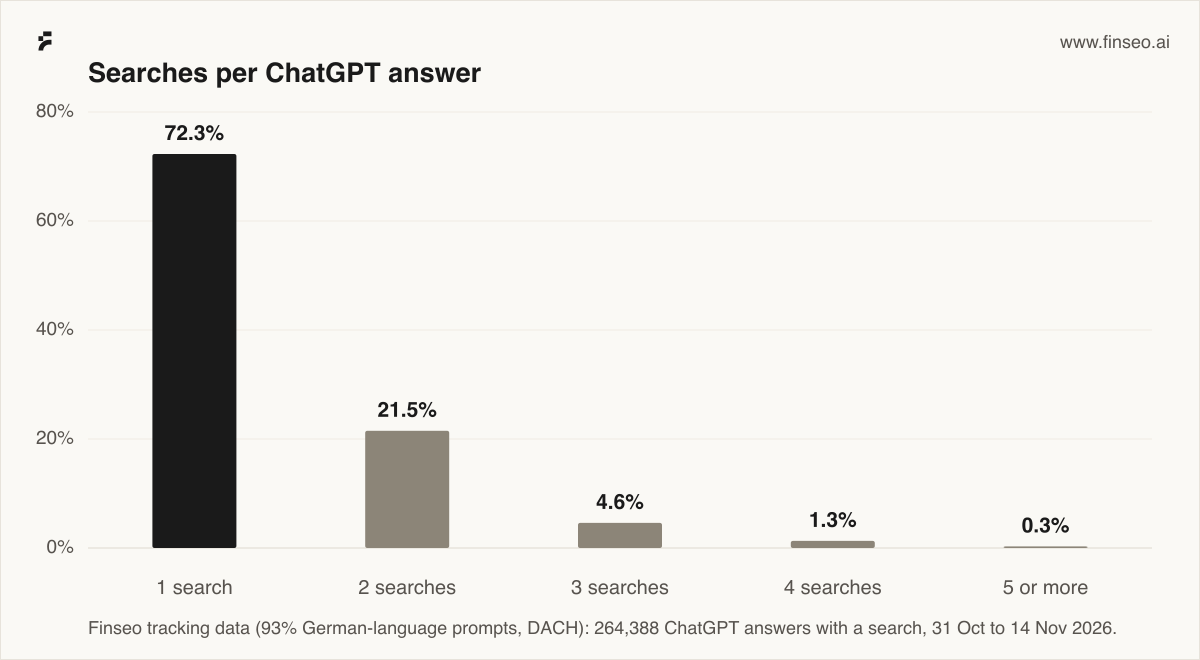
Per answer, then, fan-out in ChatGPT is narrow. Per prompt it is wide. A prompt tracked on at least ten days in that window collected a median of 16 different searches in 15 days, because almost every day brought new ones. That second number is the one that decides how much content a prompt can pull in.
One caution on the per-answer count. On 30 October 2026 ChatGPT's behaviour shifted in our data: the share of answers with two or more searches fell from about 42% to about 27%, and the mean from 1.52 to 1.36, with the same reported model label on both sides. We cannot tell whether OpenAI or the capture route changed. In the 15 days before the shift the mean was 1.50, which is the range to expect when the next change lands.
How much do the searches change from day to day?
Hardly any search string survives to the next day. We took each prompt's first ChatGPT answer per UTC day and compared consecutive days.
| Measure, consecutive days of the same prompt | ChatGPT | Claude |
|---|---|---|
| Measure, consecutive days of the same promptDay pairs with no identical search | ChatGPT96.8% | Claude58.3% |
| Measure, consecutive days of the same promptDay pairs with an identical set of searches | ChatGPT1.9% | Claude33.7% |
| Measure, consecutive days of the same promptExact-string overlap (Jaccard, mean) | ChatGPT2.4% | Claude37.1% |
| Measure, consecutive days of the same promptWord overlap (Jaccard, mean) | ChatGPT53.5% | Claude72.8% |
| Measure, consecutive days of the same promptUnique strings per search executed | ChatGPT92.3% | Claude50.4% |
| Measure, consecutive days of the same promptHow often a prompt's most common search recurs (median prompt) | ChatGPT9.1% of days | Claude54.5% of days |
Base: 239,458 consecutive day pairs for ChatGPT and 4,816 for Claude, 31 October to 14 November 2026; the last row covers 16,260 ChatGPT prompts and 391 Claude prompts with searches on at least ten days.
The two overlap rows tell the real story. ChatGPT's searches share about half their words from one day to the next and almost none of their exact phrasing. It keeps the topic, the product category and the place, and reshuffles the modifiers around them: a price word one day, a review word the next, a different year or a second country.
Claude behaves like a different kind of system. A third of its consecutive days produced exactly the same searches, and for the median prompt the single most common search showed up on more than half of the days. If you want to know what Claude will look up for a prompt, yesterday's search is a decent guess. For ChatGPT it is not.
The practical consequence: a list of "the fan-out queries for this prompt" taken from one ChatGPT run is a sample of one. Read fan-outs over two weeks and group them by intent, which is what query fan-out analysis is built to do, rather than writing to one day's strings.
Are fan-out queries longer than the prompt?
In ChatGPT, no, they are about the same length. In Claude they are roughly half as long.
| Length | ChatGPT | Claude |
|---|---|---|
| LengthMedian words per search | ChatGPT10 | Claude5 |
| LengthMedian words in the prompt behind it | ChatGPT9 | Claude9 |
| LengthSearches shorter than their prompt | ChatGPT43.5% | Claude90.2% |
| LengthSearches longer than their prompt | ChatGPT46.8% | Claude5.2% |
| LengthSearches of 9 words or more | ChatGPT69.9% | Claude4.3% |
Base: 359,243 ChatGPT searches and 7,692 Claude searches, 31 October to 14 November 2026.
ChatGPT's searches are not short keywords. They are long strings of stacked terms: a product category, a place, a year, then two or three qualifiers such as price, reviews or providers, without the grammar of the original question. Claude writes something closer to a classic search query of five words.
That length matters on Google too. In Pew Research Center data on 68,879 Google searches by 900 US adults in March 2025, just 8% of one or two word searches produced an AI summary, against 53% of searches with 10 words or more and 60% of searches that began with a question word. ChatGPT's median search of 10 words sits in the length band where Google most often answers with AI itself.
ChatGPT's queries also got longer at the 30 October shift, from 9.4 to 10.0 words on average. The earlier figures we published from older ChatGPT data, with most searches at five to eight words, describe that older behaviour.
What fan-out queries add: years, places, brands and comparisons
We checked every search for terms its own prompt did not contain. "Added" below means the search has the term and the prompt does not.
| Added to the search, not in the prompt | ChatGPT, share of searches | Claude, share of searches |
|---|---|---|
| Added to the search, not in the promptA country or market name | ChatGPT, share of searches50.1% | Claude, share of searches6.3% |
| Added to the search, not in the promptA year | ChatGPT, share of searches30.7% | Claude, share of searches29.0% |
| Added to the search, not in the promptReview or test terms | ChatGPT, share of searches10.5% | Claude, share of searches4.5% |
| Added to the search, not in the promptPrice or cost terms | ChatGPT, share of searches8.2% | Claude, share of searches1.8% |
| Added to the search, not in the promptComparison terms (vs, compare, alternatives) | ChatGPT, share of searches8.0% | Claude, share of searches6.1% |
| Added to the search, not in the promptA brand, product or organisation the prompt did not name | ChatGPT, share of searches19.5% | Claude, share of searches5.6% |
| Added to the search, not in the promptThe tracked brand itself, when the prompt did not name it | ChatGPT, share of searches3.4% | Claude, share of searches1.5% |
Base: 359,243 ChatGPT searches and 7,692 Claude searches, 31 October to 14 November 2026.
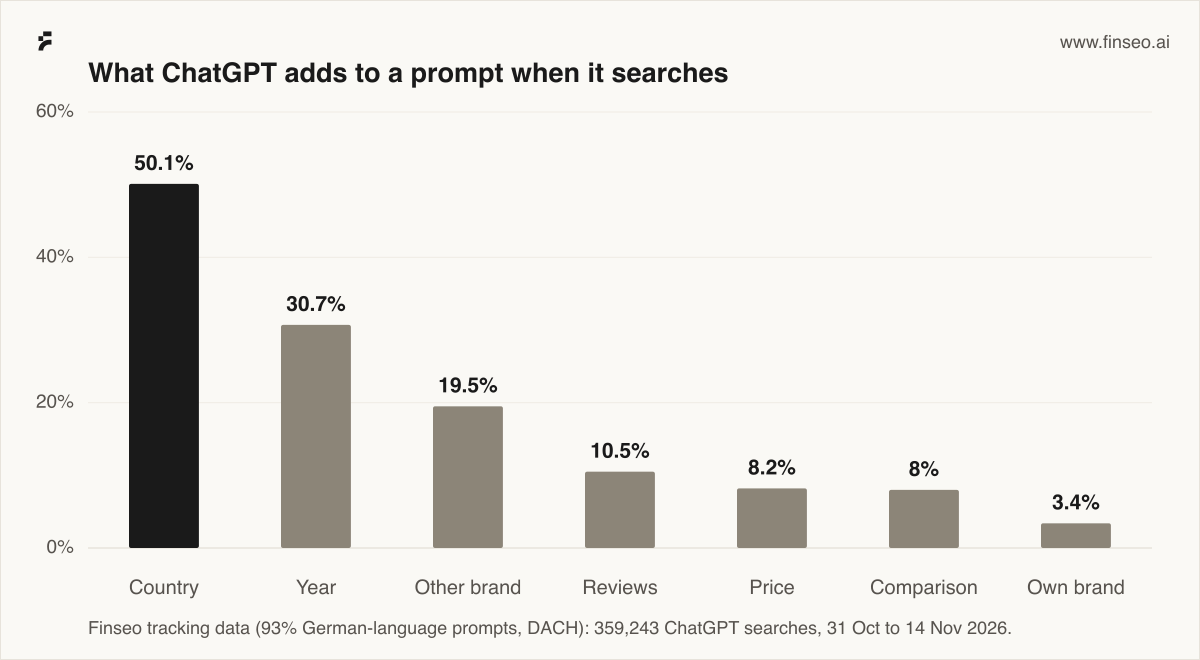
Places come first. Half of ChatGPT's searches name a country or market the prompt never mentioned, overwhelmingly the market the prompt is tracked in. ChatGPT localises the search even when the user did not ask it to, so a page that never states which market it serves gives away the most common qualifier.
Years are almost always the current one. 31% of ChatGPT searches contain a year, and 89.8% of those years are 2026, with 7.4% at 2025. Claude's share is similar, at 99.3% current year. In our November data the searches carry the current year, not last year's.
Named brands arrive through the search. One ChatGPT search in five names a brand, product or organisation from the prompt's category that the prompt itself left out. The brand the customer tracks appeared unprompted in only 3.4% of searches. In other words, ChatGPT pulls the established names of a category into the retrieval step itself, which is one more reason the incumbents keep getting cited.
Two operators disappeared. In the 15 days to 30 October, 4.6% of ChatGPT searches used site: to search one website and 14.1% contained the word "official". After the shift those fell to 0.5% and 5.1%. Both patterns were common in our own data two weeks earlier, and both look different now.
Do non-English prompts fan out in English?
Mostly not, in our data. For German prompts, ChatGPT's searches were classified as:
| Language of the search | ChatGPT, German prompts | Claude, German prompts |
|---|---|---|
| Language of the searchGerman | ChatGPT, German prompts80.5% | Claude, German prompts70.4% |
| Language of the searchEnglish | ChatGPT, German prompts7.9% | Claude, German prompts4.8% |
| Language of the searchUndetermined (brand and product names only) | ChatGPT, German prompts11.6% | Claude, German prompts24.8% |
Base: 305,597 ChatGPT searches and 6,326 Claude searches for German prompts, 31 October to 14 November 2026.
So between 7.9% and 19.5% of ChatGPT's searches for German prompts were English, depending on whether the undetermined strings count. The 15 days before the shift gave 11.5% English. Claude stayed in German almost entirely.
Two limits apply. Short searches full of product names are hard to classify, so we counted a search as English only when English function words outnumbered German ones, which makes 7.9% a lower bound. And the German prompts in our corpus lean toward local services and German-market products, where an English search makes little sense. Software and technical categories almost certainly push the English share higher. Only German prompts met our reporting base. English prompts are a small subsample in which a single account supplies more than a quarter of the searches, so we left them out, along with every other language.
How our figures compare with the engine makers' documentation
Our data shows 1.36 searches per ChatGPT answer, 92.3% unique search strings over 15 days (89.6% in the window before) and 7.9% to 19.5% English searches for German prompts. The published reference points we can cite with a source are the engine makers' own documents: Anthropic puts Claude at typically 1 to 3 searches for a single fact and 10 or more for comparative research, against the 1.14 we recorded when Claude searched, and Google says AI Overviews and AI Mode issue "multiple related searches" without giving a number. What gets counted moves these figures a lot: we query ChatGPT in a configuration that searches on 99.8% of answers, so counts from setups that search less often are not comparable, and the category decides how often an English search makes sense at all.
What this means for content and tracking
Plan for intents, not strings. With 96.8% of ChatGPT day pairs sharing no search, any one day's fan-out list is noise at the string level. Its words are stable (53.5% overlap), so group searches by the qualifiers they carry and write for those.
State the market and the year on the page. ChatGPT adds a country to half its searches and the current year to almost a third. A page that names neither leaves out the two qualifiers the engine adds most often. That is the cheapest change in AI content optimization we can point to from this data.
Expect the category's big names in the retrieval step. One ChatGPT search in five names a brand, product or organisation that the prompt left out. Comparison and alternatives pages that mention those names explicitly sit where those searches land.
Track ChatGPT and Claude separately. ChatGPT searches on nearly every answer and reformulates daily; Claude searches on 39.1% and repeats itself. A combined fan-out report would hide both patterns. Track them per engine, as ChatGPT visibility tracking and Claude visibility tracking do, and feed recurring intents back into prompt research for AI search.
Recheck after model changes. The 30 October shift changed the search count, the length and two operators overnight. Fan-out benchmarks age in weeks, not years. The same caution applies to the citation side, where even two Google surfaces share only 13.7% of their cited URLs.
Method note
Data, scope and reporting rules. The figures come from Finseo's own tracking data: the answers AI engines gave to the prompts our customers track, aggregated across several hundred customer projects. This article is one of three studies drawn from that data; citation stability and query fan-out cover 16 October to 14 November 2026, the most-cited domains 18 October to 14 November 2026 (UTC days, ending the day before the analysis). Before counting we removed every account that belongs to Finseo, its team or its founders' other companies, all admin, test, demo and pilot accounts, and every pitch or demo project in any account, together with archived and deleted prompts. Every reported cell rests on at least 10 customer accounts, and no figure is reported where a single account supplies more than 25% of the underlying answers or prompts; engines, markets and domains that miss this base are left out, and the text says so. Between 92% and 93% of the answers come from prompts tracked for Germany, Austria and Switzerland, so the results describe German-language AI search in Germany and the DACH region, not AI search worldwide. Prompts are chosen by customers and phrased commercially, so the corpus is large but not a random sample of searches. No customer, no customer's brand, no prompt and no answer is shown.
Window and sample. Headline figures cover 31 October to 14 November 2026. Every headline figure was computed a second time on 16 to 30 October 2026, and the core counts were recomputed with a second, independent calculation: Claude's counts came out identical, ChatGPT's answer count differed by 0.2% because the data kept changing between the two runs, and every rate agreed within 0.1 points. Over both windows the sample holds about 490,000 ChatGPT answers and 32,000 Claude answers to about 22,700 prompts, with about 711,000 recorded searches. In the headline window: ChatGPT 265,029 answers to 22,407 prompts; Claude 17,198 answers (6,733 with a search) to 1,536 prompts. No search string is quoted.
Engines. ChatGPT and Claude are the only engines whose searches we store and that meet the reporting base. Claude rests on a far smaller base than ChatGPT, so read its figures as less settled. Microsoft Copilot, which appears in other Finseo data, is not part of this study: no search text is stored for it, and its answers come from too few accounts to report.
Metrics. Searches per answer counts distinct search strings within one answer. Day-to-day overlap compares the first answer per prompt and UTC day on consecutive days, after lowercasing and whitespace normalisation. Uniqueness is distinct strings divided by searches executed, per prompt and engine over the window. Length is counted in words. Added terms are matched with multilingual term lists against the search and its prompt. Language is classified German or English by function words, with brand-only strings left undetermined.
Biases. The prompts describe buying decisions, and the mix leans toward local services, e-commerce and B2B. ChatGPT is queried in a configuration that searches on almost every answer, which is not how every ChatGPT session behaves. Search-volume overlap could not be measured, because keyword volumes are not joined to these searches in our data.
FAQ
What is query fan-out in AI search? It is the step where an AI engine turns one prompt into one or more web searches, retrieves sources for each and writes one answer. In our data ChatGPT ran 1.36 searches per answer and Claude 1.14 when it searched.
How many searches does ChatGPT run per prompt? Usually one, sometimes two: 72.3% of ChatGPT answers ran one search and 21.5% ran two, for a mean of 1.36. Over 15 days of daily tracking, though, a prompt collected a median of 16 different searches.
Does ChatGPT search the same way every day? No. On 96.8% of consecutive days, a prompt's ChatGPT searches shared no identical string, while about half of their words stayed the same. 92.3% of all search strings were unique.
How does Claude's fan-out differ from ChatGPT's? Claude searched in 39.1% of answers, wrote shorter searches (five words against ten) and repeated itself: a third of consecutive days had exactly the same searches, against 1.9% for ChatGPT.
Do AI engines add the year to searches? Often. 31% of ChatGPT searches and 29% of Claude searches contained a year the prompt did not, and about nine in ten of those years were the current one.
Does ChatGPT search in English for non-English prompts? Rarely, in our data: 7.9% of searches for German prompts were clearly English, up to 19.5% if strings of only product names are counted. The share depends heavily on category and on how language is classified.
Can I see the fan-out queries for Gemini or Google AI Mode? Not from the consumer products in a form we can store. Our figures cover ChatGPT and Claude because those engines expose their searches.
Finseo records the searches behind your prompts per engine, groups them by intent and shows which ones your pages answer. See query fan-out analysis.
Sources
Ours
- Finseo tracking data (about 93% German-language prompts, DACH): 265,029 ChatGPT answers and 17,198 Claude answers with their recorded searches, 31 October to 14 November 2026
- Finseo tracking data: second window for every headline figure, 16 to 30 October 2026
- Finseo tracking data: daily ChatGPT search behaviour, 16 October to 14 November 2026, including the 30 October shift
External
- Google Search Central, AI features and your website: https://developers.google.com/search/docs/appearance/ai-features
- Anthropic, Web search tool documentation: https://platform.claude.com/docs/en/agents-and-tools/tool-use/web-search-tool
- Pew Research Center (July 2025), Google users are less likely to click on links when an AI summary appears in the results, 68,879 searches by 900 US adults, March 2025: https://www.pewresearch.org/short-reads/2025/07/22/google-users-are-less-likely-to-click-on-links-when-an-ai-summary-appears-in-the-results/
- Ma et al. (EMNLP 2023), Query Rewriting for Retrieval-Augmented Large Language Models: https://arxiv.org/abs/2305.14283
Google Search
Save Finseo as a preferred source to see our articles more often in Top Stories, AI Overviews and AI Mode.