
Query fan-out is what Google AI Mode does before it answers: it rewrites your one question into several synthetic searches, retrieves sources for each, then writes a single reply.
The measured estimate is about nine of those searches per prompt, and 95% of them have no traditional search volume at all. That combination is why a page can be invisible in keyword tools and still be the source an answer is built on. This article covers what Google has confirmed, what the measurements actually show, what you can and cannot see in Search Console, and what to do about it.
What Google has confirmed, and what it has not
Google's Search Central documentation states that AI Mode and AI Overviews may issue "multiple related searches across subtopics and data sources", then identify supporting pages and synthesise a response. At I/O 2025 Google described AI Mode breaking a question into subtopics and issuing "a multitude of queries simultaneously". Its Deep Search variant can issue hundreds of searches, which is a separate and far more intensive mode.
The patents fill in the mechanism. US11769017B1, "Generative summaries for search results" (Google LLC, published 2023) describes selecting documents responsive not only to the submitted query but to related, recent and implied queries, then combining those document sets before sending selected content to a model. US20240289407A1, "Search with Stateful Chat" (2024) adds conversational state and synthetic queries.
What Google has never published is a number. There is no official count of sub-queries per prompt, no branch level reporting, and no confirmation that the API behaviour matches the consumer product. Every figure below is a measurement by someone outside Google.
How many searches does one prompt trigger?
| Figure | Source, year | Status |
|---|---|---|
| 9.06 fan-out queries per prompt | Nectiv, 2025: ~9,000 prompts, 70,000+ fan-out rows via Gemini 3 grounding data | Measured proxy, not a Google disclosure |
| 59% of prompts produced 5 to 11 queries | Nectiv, 2025 | Measured proxy |
| 24% produced 12 to 19 queries | Nectiv, 2025 | Measured proxy |
| 28 queries | Nectiv, 2025 | Observed maximum, not a platform limit |
| 10.7 queries per prompt | Seer Interactive, 500 prompts, Gemini 3 | Measured proxy |
| 5 to 16 per turn, 9 to 11 for complex B2B prompts | Pepper Content, 2026 | Industry estimate, method not fully disclosed |
| Hundreds of searches | Google, I/O 2025 | Official, but for Deep Search only |
The defensible sentence, and the one we use: about nine fan-out searches is the strongest current estimate, five to eleven is the common range, and 28 is an observed upper tail rather than a documented ceiling. Nectiv itself cautions that its Gemini API extraction may not be the exact implementation behind AI Mode.
Fan-out breadth also varies by category, which matters more for planning than the average does.
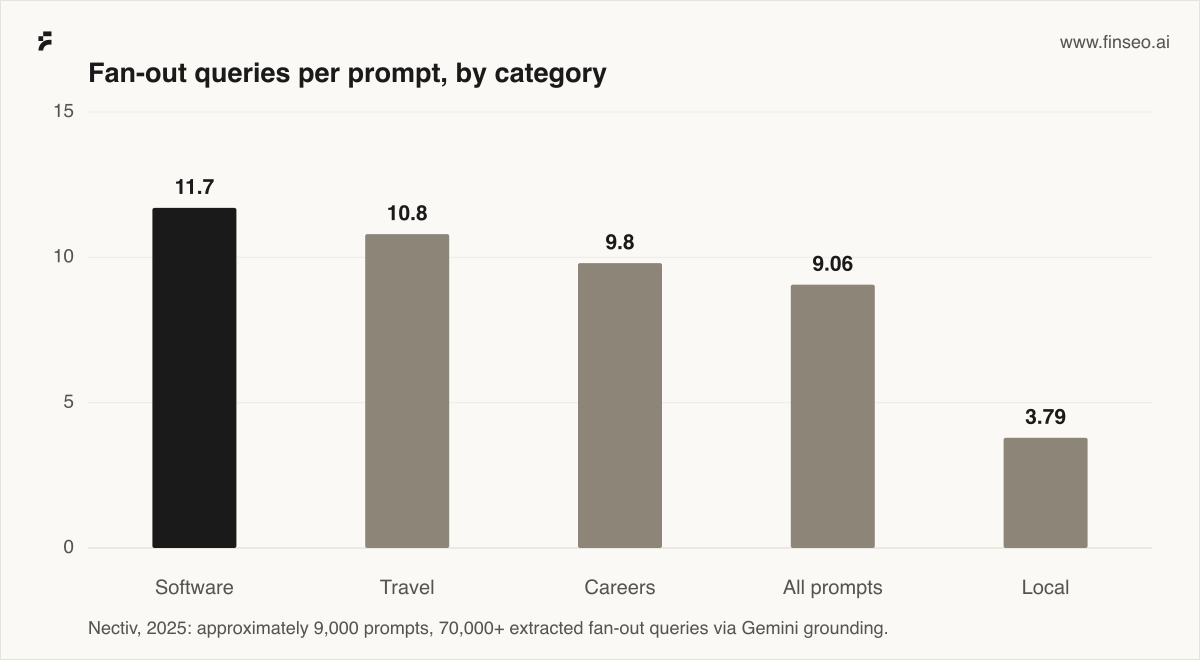
A software or travel query fans out roughly three times as wide as a local one. If you sell software, one prompt puts eleven or twelve retrieval slots on the table, and you are competing for each of them separately.
What the sub-queries look like
Nectiv's dataset gives the shape: 77% of fan-out queries were five to eight words, with a mean of 6.7. They skew toward review, comparison, pricing, freshness and competitor intents rather than restating the head term. Year mentions were common, and oddly, 45% of those mentions were "2024" in a study run in late 2025, which is a useful reminder that the model's sense of "current" lags the calendar.
The commercial consequence sits in a different dataset. AirOps, analysing 15,000 prompts and 548,534 retrieved pages in 2026, found that 32.9% of cited pages that ranked in Google's top 20 appeared only for a fan-out query, not for the original prompt, and that 95% of fan-out queries had zero traditional monthly search volume.
Read those two numbers together and the strategy writes itself. A third of your citation opportunities live behind questions your keyword tool reports as non existent, because nobody types them. The model generates them.
What our own data adds, and what it cannot
We record fan-out queries where an engine exposes them, which today means 864,409 observed fan-out queries in our corpus. Two findings, with a caveat that decides how to read both.
The caveat first. Our fan-out capture comes from ChatGPT, where the observable sub-queries per answer average 1.30, median 1, with 2.0% of answers showing five or more and a maximum of 54. That is not a contradiction of the nine per prompt figure above, it is a different surface: Nectiv extracted AI Mode style fan-outs from Gemini grounding metadata, we record what ChatGPT exposes. The lesson is the one this whole article turns on. The count you get depends entirely on which surface you can observe, and nobody is measuring AI Mode's internal fan-out directly.
The finding that does transfer is the shape of the queries. Across those 864,409 observed fan-outs, 59.6% are five to eight words, 19.5% are nine to twelve, and only 17.1% are four words or fewer.
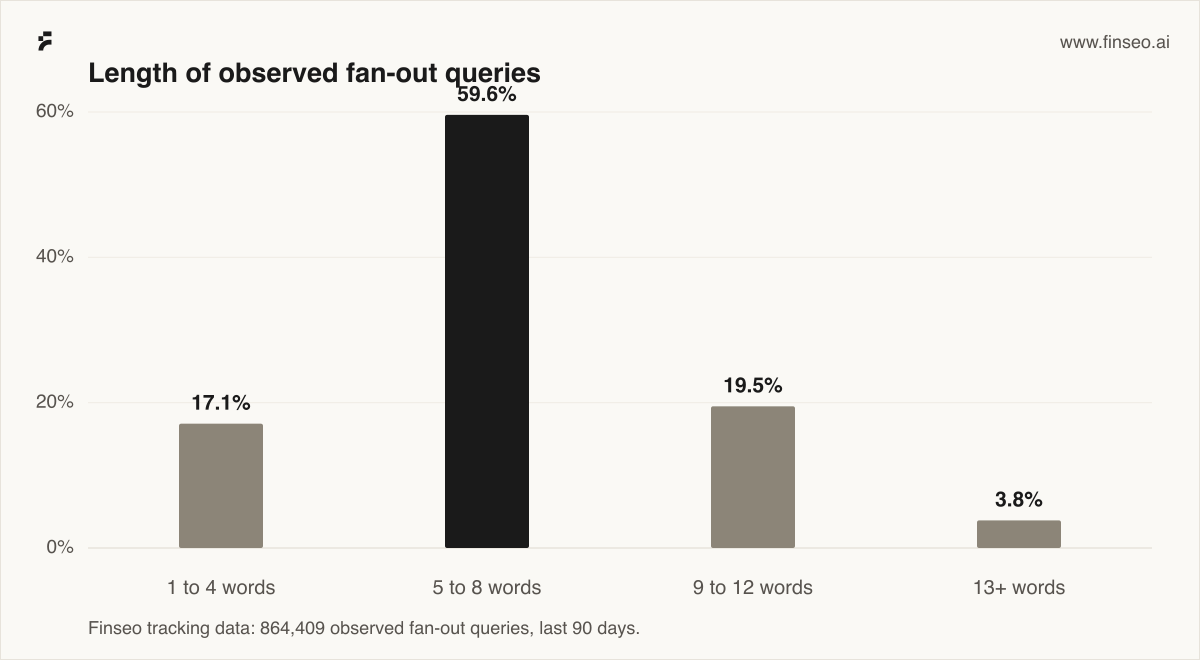
That lands close to Nectiv's 77% at five to eight words on a completely different extraction method, which is about as much corroboration as this field currently offers. Fan-outs are phrases, not keywords, and they are longer than the head term almost every time.
Do different sub-queries pull different sources?
Yes, and the evidence is consistent across three independent measurements.
- Semrush, 2025, across 5,000 keywords and more than 150,000 citations, found AI Mode had roughly 54% domain overlap and 35% URL overlap with Google's organic top ten. The sidebar appeared in 92% of AI Mode responses, averaging seven unique domains.
- Our own tracking runs the same prompts against AI Mode and AI Overviews on the same day, which makes the comparison direct. Across 42,937 prompt-days in a 14 day window, the two surfaces shared only 13.7% of cited URLs and 18.7% of cited domains. AI Mode cited 10.79 URLs per answer against 6.31 for AI Overviews. Independently, Ahrefs measured the same 13.7% URL overlap across 540,000 query pairs, and found the answers themselves about 86% semantically similar. Two Google surfaces reach nearly the same answer while citing almost entirely different pages.
The patent evidence explains why. Document selection is described as query dependent, query independent and user dependent, so freshness, locality, language and authority can shift the source pool from one branch to the next.
What nobody has published is a public dataset mapping each individual sub-query to its complete result set and its contribution to the final citation. Anyone selling you a precise per branch attribution model is modelling, not measuring.
A worked example
Take one commercial prompt: "best project management tool for a 20 person agency". On the Nectiv distribution, a software query of that shape fans out to roughly a dozen branches. They are not synonyms of the prompt. They look like this:
| Branch intent | Typical sub-query shape | Who tends to win it |
|---|---|---|
| Category definition | "project management software for agencies" | category pages, established review sites |
| Comparison | "asana vs monday for agencies" | comparison pages, G2 style listings |
| Pricing | "monday.com pricing per user 2026" | pricing pages, aggregators |
| Alternatives | "alternatives to asana small team" | alternatives pages, competitor blogs |
| Constraint fit | "project management tool 20 users" | docs and plan pages with explicit limits |
| Freshness | "best agency project tools 2026" | anything dated this year |
| Proof | "agency project management case study" | case studies, customer stories |
| Objections | "asana too complex for small agency" | forums, review sites, Reddit |
Your product page answers the first branch, possibly the fifth. The other six are answered by somebody else, and their pages become the sources for the answer that names your competitor. That is the practical meaning of fan-out: you are not competing for one slot, you are absent from most of them.
Two rules follow. Publish for the intents, not the phrasings, because ten five word variants of the same question do not need ten pages. And accept that some branches are not yours to win: for the objections branch, the source is usually a forum thread, which is a AI citation tracking and community question rather than a content one.
What you can see in Search Console
As of 31 August 2026, Google's documentation states that AI Mode and AI Overview appearances are included in Search Console's overall Search traffic, historically under the Web search type. The dedicated Search Generative AI performance report adds impressions in generative features, the pages that appeared, country and device breakdowns, and date granularity down to the hour. It had rolled out worldwide by that date.
| You can see | You cannot see |
|---|---|
| Impressions in generative AI features | The text of the synthetic sub-queries |
| Which of your URLs appeared | Branch level impressions or rankings |
| Country and device splits | The full candidate source pool per branch |
| Hourly to monthly trends | Which branch caused a given citation |
The Gemini API is a partial exception: it can return the model's executed search queries in its grounding metadata. That is a developer capability, and it should not be confused with what the consumer product reports. It is also the mechanism behind most of the fan-out counts above, which is exactly why those counts are proxies.
Does optimising for fan-out work?
There is one published before and after test, and it is worth reading honestly.
Semrush, 2025, expanded four articles using ten to twenty synthetic fan-out queries each. Across 33 tracked queries, citations rose from 2 to 5 in a month, a 150% increase, having peaked at 9 before falling back. In the same period, brand visibility fell from 13.6% to 10.6%, share of voice from 23.4% to 20.0%, and brand mentions from 18 to 10.
So: citations up, brand metrics down, on four articles and 33 queries over one month. That is directional evidence with real volatility attached, not a causal benchmark. The honest reading is that covering fan-out intents plausibly earns more citations, and that a one month before and after on a small sample cannot separate the change from normal churn.
A working method
- Get the actual fan-outs, do not guess them. Generators produce plausible sub-queries; the grounding metadata produces observed ones. The gap between the two is the whole point. Query fan-out analysis for AI Mode exists to show the observed set for your prompts.
- Group them by intent, not by keyword. Review, comparison, pricing, alternatives, freshness. Nectiv's data says those five carry most of the branches in commercial categories. If the objections branch belongs to a forum, that is a AI brand sentiment tracking problem before it is a content one.
- Decide coverage per intent, not per query. Ten near identical five word queries do not need ten pages. They need one page that answers that intent completely, with the entities named.
- Put the answer where it gets read. Growth Memo's 2026 analysis of 1.2 million AI answers found 44.2% of citations came from the first 30% of the page, one of the techniques with measured evidence behind it.
- Date the page and keep it current. Sprinklr's SIGIR 2026 study found recency odds ratios from 14.4 to above 10,000 across systems. The "2024" pattern in fan-out queries says the same thing from the other side.
- Measure the citation set, not the ranking. With 13.7% URL overlap between two surfaces of the same engine, a rank check tells you very little about whether you are in the answer.
Where fan-out breaks the usual reporting
Three habits stop working once you accept the mechanism.
Rank tracking for one keyword. The prompt has a dozen branches and each pulls its own sources, and even two surfaces of the same search engine share only 13.7% of their cited URLs. A rank for the head term describes one branch at best.
Counting impressions as visibility. Search Console reports that a URL appeared in a generative feature. It does not say whether the model used it, quoted it, or listed it in a sidebar nobody opened. The AirOps figure is the sharper one here: 85% of retrieved pages never make it into the answer.
Judging a page by its own traffic. A page can win a fan-out branch, feed the answer, and receive no click at all, because the answer resolved the question. Its value shows up as a mention in an answer and, later, as a branded search or a direct visit. Measuring it needs AI search attribution rather than a sessions report.
What this changes about keyword research
Classic keyword research asks what people type. Fan-out asks what the model asks on their behalf, and those sets barely intersect: 95% of fan-out queries have no measurable volume.
That does not make keyword tools useless. Ranking first still made a page 3.5 times more likely to be cited in the AirOps data, so classic performance feeds the machine. It does mean a second research layer sits on top: the observed sub-queries per topic, refreshed as they change, treated as its own coverage checklist. That is what prompt research for AI search does at the prompt level, and what fan-out analysis does one layer down.
Method note
Our figures come from Finseo tracking data: 864,409 fan-out queries observed in the last 90 days, aggregated across accounts, with no customer or project identifiable. They cover the surfaces that expose sub-queries to us, which is why they describe ChatGPT rather than AI Mode, and we say so at the point of use rather than in a footnote.
Google has confirmed the mechanism and not the numbers. Every count in this article is an outside measurement, mostly derived from Gemini grounding metadata rather than from consumer AI Mode, and each is labelled with its sample and year. Where a figure is an observed maximum, an estimate or a proxy, the table says so.
Each source was checked before quoting. Finseo runs fan-out analysis as a product, so treat our framing as informed and interested; the numbers here are other people's, and we have not adjusted them.
FAQ
What is query fan-out? It is the step where an AI search system rewrites one prompt into several synthetic searches, retrieves sources for each and synthesises one answer. Google confirms the behaviour in its Search Central documentation and describes it in patent US11769017B1.
How many sub-queries does AI Mode generate? About nine per prompt on the strongest current estimate, commonly five to eleven, with 28 observed as an upper tail. Google has published no official number.
Can I see the fan-out queries for my site? Not in Search Console. It reports impressions, pages, countries, devices and dates for generative features, but not the sub-query text or which branch produced a citation. The Gemini API can return executed search queries, which is how most published counts were produced.
Are fan-out queries worth optimising for? The one published test moved citations from 2 to 5 across 33 queries in a month, while brand metrics fell in the same window. Treat it as directional. The stronger argument is structural: a third of cited top-20 pages appeared only for a fan-out query.
Do fan-out queries have search volume? Mostly none. 95% had zero traditional monthly volume in the AirOps analysis, which is why keyword tools cannot see this layer.
Is fan-out the same in AI Overviews and AI Mode? No. The two surfaces overlapped on only 13.7% of cited URLs in the Ahrefs comparison, while producing about 86% semantically similar answers.
Finseo extracts the observed fan-out queries behind your prompts, tracks which sources each branch pulls, and reports where you are missing from the answer. See query fan-out analysis.
Sources
Ours
- Finseo tracking data: 864,409 observed fan-out queries and their length distribution, last 90 days
- Finseo tracking data: 42,937 prompt-days comparing AI Mode with AI Overviews on the same prompt, 14 day window
External
- Google Search Central, guidance on AI features and websites (2025 to 2026)
- Google LLC, US11769017B1, Generative summaries for search results (published 2023); US20240289407A1, Search with Stateful Chat (2024)
- Nectiv (2025), approximately 9,000 prompts and 70,000+ extracted fan-out queries
- Seer Interactive, 500 prompt Gemini 3 fan-out study
- Semrush (2025), 5,000 keywords and 150,000+ citations; and the four article fan-out optimisation test
- Ahrefs (2025), 540,000 query pairs comparing AI Mode with AI Overviews, an independent replication of our overlap figure
- AirOps (2026), 15,000 prompts and 548,534 retrieved pages
- Kevin Indig, Growth Memo (2026), 1.2 million AI answers
- Vishwakarma et al., What Gets Cited: Competitive GEO in AI Answer Engines, Sprinklr, ACM SIGIR 2026
Google Search
Save Finseo as a preferred source to see our articles more often in Top Stories, AI Overviews and AI Mode.