Google AI Mode and AI Overviews are two answer surfaces on the same search engine, and on the same query they share only 13.7% of their cited URLs.
That gap matters to anyone reporting AI visibility, because it means one surface is a poor proxy for the other. Across 45,024 prompt-days where both surfaces answered, a brand that Google named at all was named on only one of the two surfaces 51.2% of the time.
Google says the two will diverge. This is by how much
An AI Overview is the generated block inside an ordinary Google results page. AI Mode is a separate tab with a conversational thread, follow-up questions and no ten blue links underneath. Different entry points, different products.
Google states the consequence plainly in its Search Central documentation on AI features: "AI Mode and AI Overviews may use different models and techniques, so the set of responses and links they show will vary." The same page describes the retrieval both surfaces run: "Both AI Overviews and AI Mode may use a 'query fan-out' technique, issuing multiple related searches across subtopics and data sources, to develop a response." We covered that mechanism, the patents behind it and the measured branch counts in query fan-out analysis for Google AI Mode.
Google also sets one shared precondition: "To be eligible to be shown as a supporting link in AI Overviews or AI Mode, a page must be indexed and eligible to be shown in Google Search with a snippet." Both surfaces draw from pages that classic Search can already show. What Google does not publish is how far apart the two selections end up. That has to be measured.
The two surfaces cite different pages
Finseo runs the same prompts against AI Mode and AI Overviews on the same day, which makes the comparison direct rather than inferred. Across 42,937 prompt-days in a 14 day window:
| Measure | Google AI Mode | Google AI Overviews |
|---|---|---|
| Cited URLs per answer | 10.79 | 6.31 |
| Shared cited URLs, per prompt-day | 13.7% | 13.7% |
| Shared cited domains, per prompt-day | 18.7% | 18.7% |
Overlap is computed per prompt-day and then averaged, so one prompt with fifty citations cannot drag the result.
Ahrefs measured the same 13.7% citation overlap across 540,000 US query pairs in September 2025, found the answers 86% semantically similar on a separate sample of 730,000 pairs, and summarised it this way: "9 out of 10 times, AI Mode and AI Overview agreed on what to say; they just said it differently and cited different sources." Two independent samples, two methods, the same figure.
That pairing is the finding. The surfaces reach nearly the same conclusion out of almost entirely different pages. Ahrefs also reports overlap rising only to 16.3% among the top three citations, so the shared portion is not simply the most prominent sources agreeing.
Domain overlap runs higher than URL overlap in our data, 18.7% against 13.7%, which says part of the shared sliver is the same publishers cited through different articles rather than the same articles twice.
The published overlap figures disagree, and the reason is the unit
Anyone researching this will find numbers between 13.7% and 88%. They are not measuring the same thing.
| Study | Sample | Reported overlap | Unit |
|---|---|---|---|
| Finseo, 2026 | 42,937 prompt-days, both surfaces same day | 13.7% URLs, 18.7% domains | Per prompt-day, then averaged |
| Ahrefs, September 2025 | 540,000 US query pairs | 13.7% citations, 16.3% in top three | Per query pair |
| BuzzStream, 2026 | 595 prompts, about 30,000 citations | 37.4% | Jaccard set similarity |
| Semrush, 2025 | 5,000 keywords, 150,000+ citations | 58% URLs, 88% domains | Set intersection across the corpus |
The two low figures are per query. The two high figures pool citations across a corpus and then intersect the sets, which counts a domain as shared if it appears anywhere in either pile, not if it appeared for the same question. Both are legitimate; they answer different questions. For anyone asking "will the same page support me on both surfaces for this prompt", the per query figures are the relevant ones, and they cluster near 14%.
The BuzzStream study adds useful context on the wider field: across Google AI Mode, AI Overviews, Gemini and ChatGPT, 76.1% of citations were unique to a single platform, and the two Google surfaces were still the closest pair of the four.
Half of Google AI appearances happen on one surface only
Citation overlap is a publisher's question. The brand question is different: if a model names you in an AI Overview, does it also name you in AI Mode? We checked every prompt-day where both surfaces returned an answer.
| Outcome | Prompt-days | Share of appearances |
|---|---|---|
| Named on both surfaces | 9,332 | 48.8% |
| Named in AI Mode only | 6,806 | 35.6% |
| Named in AI Overviews only | 2,967 | 15.5% |
| Named on neither | 25,919 | n. a. |
Of 45,024 prompt-days, the brand was named somewhere on Google in 19,105 of them. Slightly more than half of those appearances, 51.2%, existed on one surface and not the other.
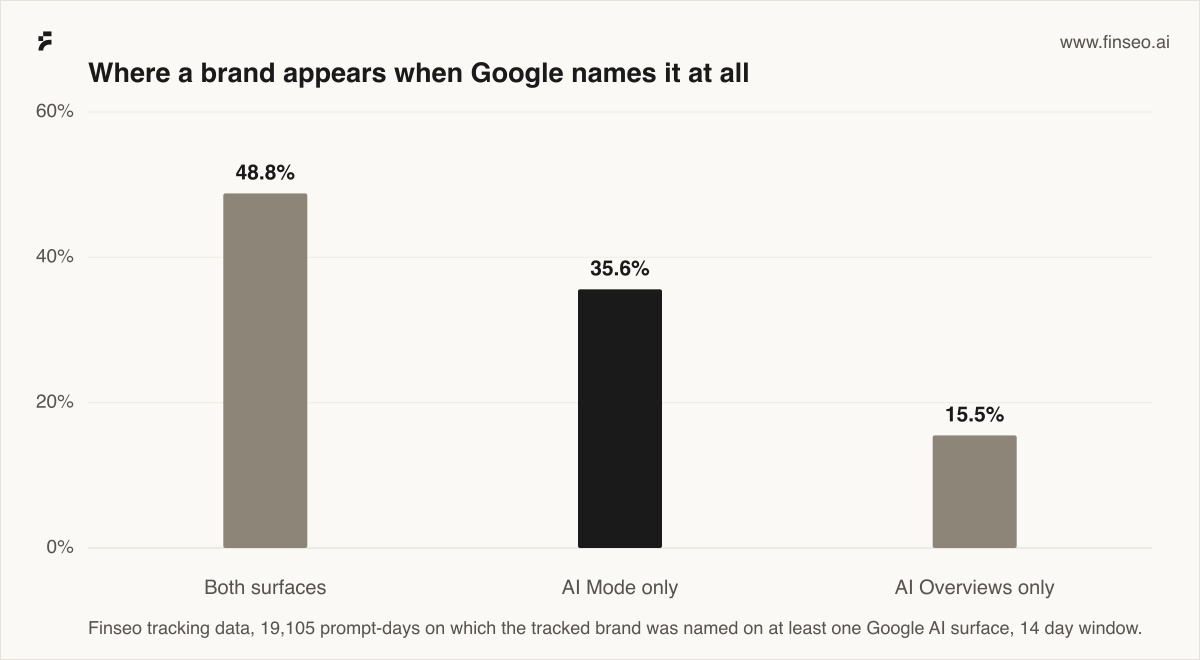
Read directionally, the asymmetry is sharper. A brand named in an AI Overview was also named in AI Mode 75.9% of the time. A brand named in AI Mode was also named in the AI Overview only 57.8% of the time. Ahrefs ran the equivalent check on entities rather than tracked brands and found an AI Overview entity reappearing in AI Mode 61% of the time, and counted 3.3 people and brand entities per AI Mode response against 1.3 for AI Overviews. Different measures, same direction: AI Mode names more, and names more that AI Overviews leaves out.
AI Mode named the tracked brand on 35.8% of prompt-days against 27.3% for AI Overviews. So AI Mode is both the more generous surface and the one more often missed, which is the practical case for treating Google AI Mode tracking as its own measurement rather than a rounding error on an AI Overviews report.
AI Mode cites more, from a narrower set
The obvious guess is that the surface citing 10.79 URLs draws on a wider pool than the one citing 6.31. It does not. In the same 14 day window:
| Measure | Google AI Mode | Google AI Overviews |
|---|---|---|
| Cited URLs with a resolvable domain | 548,404 | 1,909,591 |
| Distinct domains cited | 25,387 | 69,196 |
| Share held by the top 10 domains | 32.9% | 27.9% |
| Share held by the top 100 domains | 48.9% | 37.0% |
AI Mode puts nearly half of its citations into a hundred domains. AI Overviews spreads the same job down a much longer tail, reaching only 37.0% at the same cut. AI Mode gives each answer more slots while drawing them from a smaller regular cast.
Neither Google surface is the most generous engine we measure. In the same window Perplexity averaged 13.69 cited sources per answer against 12.95 for AI Mode and 8.73 for AI Overviews, which is why Perplexity visibility tracking tends to be the cheapest place to earn a first citation and Google the hardest to hold.
For a site outside the established set, that makes AI Overviews the easier surface to enter and AI Mode the harder one to hold. It also means a competitor set assembled from AI Overviews citations looks broader than the set that actually matters in AI Mode, which is a reason to run competitor analysis in AI search and AI citation tracking split by surface rather than pooled.
One honest disagreement to record. Ahrefs found AI Mode citing something in 97% of responses against 89% for AI Overviews. We measure the reverse: 94.6% of AI Mode answers carried at least one citation against 96.2% for AI Overviews. The samples, the periods and the markets differ, and we have not reconciled the two. Treat the direction of that particular metric as unsettled.
When an AI Overview fires, it takes the first position
Across 970,061 tracked Google results pages in the last 90 days, an AI Overview was present on 71.0% of them, and where it appeared it sat above the organic results 99.5% of the time, at an average absolute rank of 1.01. Those blocks carried an average of 11.81 references against 8.84 organic results on the same page. The generated answer cites more sources than the page beneath it lists.
That 71.0% sits far above the published figures for Google as a whole, and the gap is the sample, not a contradiction. Ahrefs, working from 55.8 million AI Overviews across a 590 million keyword index in June 2025, found AI Overviews on 9.46% of desktop keywords and roughly 16% in the United States. Their denominator is an entire keyword index, navigational and branded terms included, which rarely trigger a generated block. Ours is a set of prompts customers chose because they describe a buying decision, which is exactly the language that does.
The useful reading is not that one number is right. It is that AI Overview exposure depends almost entirely on which questions you ask about, so a category benchmark is worth more than a global average. Presence is also not a click: this measures whether the block existed, not what the user did next. For that side, see AI search attribution.
What follows for measurement
Track the two surfaces separately. With 13.7% URL overlap per prompt and 51.2% of brand appearances confined to one surface, a combined Google number hides which of the two is working. That split is the single most useful line in an AI visibility reporting.
Do not infer AI Mode from your AI Overviews report. It is the more common blind spot and the larger one, at 35.6% of appearances against 15.5% the other way. The same caution applies one level up: Google is not a proxy for the rest, and a brand's standing in ChatGPT visibility tracking moves on its own schedule.
Read AI Mode as the harder surface to keep. Higher visibility rate, more citation slots per answer, and a top-100 concentration of 48.9%. Entry is easier than persistence.
Work the branches, not the keyword. Both surfaces fan a prompt out before answering, and they do not generate the same branches. Which sub-queries a prompt produces is visible through query fan-out analysis, and it explains far more of the divergence than any ranking check will.
Expect the two to move independently. Because the underlying page sets barely intersect, an edit that lands on one surface may not show on the other for weeks. That is an argument for AI content optimization measured per surface, alongside the broader techniques we tested in nine GEO techniques tested, and for keeping both Google surfaces visible inside one view of AI visibility tracking.
Method note
Our figures come from Finseo tracking data, aggregated across accounts, with no customer, project or private domain identifiable in any number.
The overlap comparison covers 42,937 prompt-days in a 14 day window and includes only prompt-days where both surfaces returned at least one citation. The brand co-occurrence covers 45,024 prompt-days in a 14 day window and drops any prompt-day where one surface failed to return an answer, because a missing surface would otherwise read as an absence. The AI Overview placement figures cover 970,061 tracked results pages over 90 days. The concentration figures count cited URLs whose domain could be parsed, which is why they do not reconcile exactly with the average citation counts stored per answer.
Prompt sets are chosen by the customers who run them, so the corpus is large but not random. It skews toward B2B software, ecommerce and professional services, and toward commercial and comparison phrasing. Any claim about Google AI search in general should be read with that caveat, and the 71.0% presence figure in particular should not be read as a market rate.
External figures are attributed to their study with sample size and year. The Ahrefs, Semrush and BuzzStream analyses are vendor studies, large but not peer reviewed, and where they conflict with our numbers this article says so rather than picking a winner.
FAQ
What is the difference between Google AI Mode and AI Overviews? An AI Overview is a generated block inside a normal Google results page. AI Mode is a separate tab with a conversational thread and no organic results beneath it. Google states that the two "may use different models and techniques, so the set of responses and links they show will vary".
Do AI Mode and AI Overviews use the same sources? Largely not. On the same query they share 13.7% of cited URLs and 18.7% of cited domains across 42,937 prompt-days. Ahrefs found the same 13.7% across 540,000 query pairs.
If I appear in AI Overviews, will I appear in AI Mode? Usually but not reliably: 75.9% of the time in our data. The reverse is weaker, at 57.8%. Across all appearances, 51.2% existed on one surface only.
How often does an AI Overview appear? On 71.0% of the 970,061 Google results pages we tracked over 90 days, and it sat above the organic results 99.5% of the time. On a whole keyword index rather than commercial prompts the rate is far lower, around 16% in the United States.
Which surface cites more sources? AI Mode, at 10.79 cited URLs per answer against 6.31 for AI Overviews. AI Mode draws those citations from a narrower set of domains.
Why is my page cited in one surface and not the other? Both surfaces fan a prompt out into sub-queries and do not generate the same branches. A page that answers one branch precisely can be the best source for it on one surface and irrelevant on the other.
Can one tool monitor ChatGPT, Gemini and Perplexity alongside both Google surfaces? Yes, and the figures here are the reason to. The engines disagree with each other more than the two Google surfaces disagree between themselves, so a per engine breakdown is the minimum useful unit. Any tracker worth the name reports per engine rather than as one blended score.
Do I need to track both separately? Yes, if the report drives decisions. A single combined Google figure conceals which surface produced the movement, and half of all appearances exist on only one of them.
Sources
Ours
- Finseo tracking data: 42,937 prompt-days comparing cited URLs on AI Mode and AI Overviews, 14 day window
- Finseo tracking data: 45,024 prompt-days comparing brand mentions across both Google surfaces, 14 day window
- Finseo tracking data: 970,061 tracked Google results pages, AI Overview presence and placement, 90 day window
- Finseo tracking data: cited domain concentration per Google surface, 14 day window
- Finseo tracking data: cited sources per answer by engine, 14 day window
External
- Google Search Central, AI features and your website: https://developers.google.com/search/docs/appearance/ai-features
- Ahrefs (September 2025, US), 540,000 query pairs for citation overlap and 730,000 for semantic similarity: https://ahrefs.com/blog/ai-overviews-vs-ai-mode/
- Ahrefs (June 2025), 55.8 million AI Overviews across a 590 million keyword index: https://ahrefs.com/blog/insights-from-56-million-ai-overviews/
- BuzzStream (2026), 595 prompts and about 30,000 citations across four platforms, Jaccard similarity: https://www.buzzstream.com/blog/ai-citation-overlap/
- Semrush (2025), 5,000 keywords and more than 150,000 citations across four surfaces
Google Search
Save Finseo as a preferred source to see our articles more often in Top Stories, AI Overviews and AI Mode.