

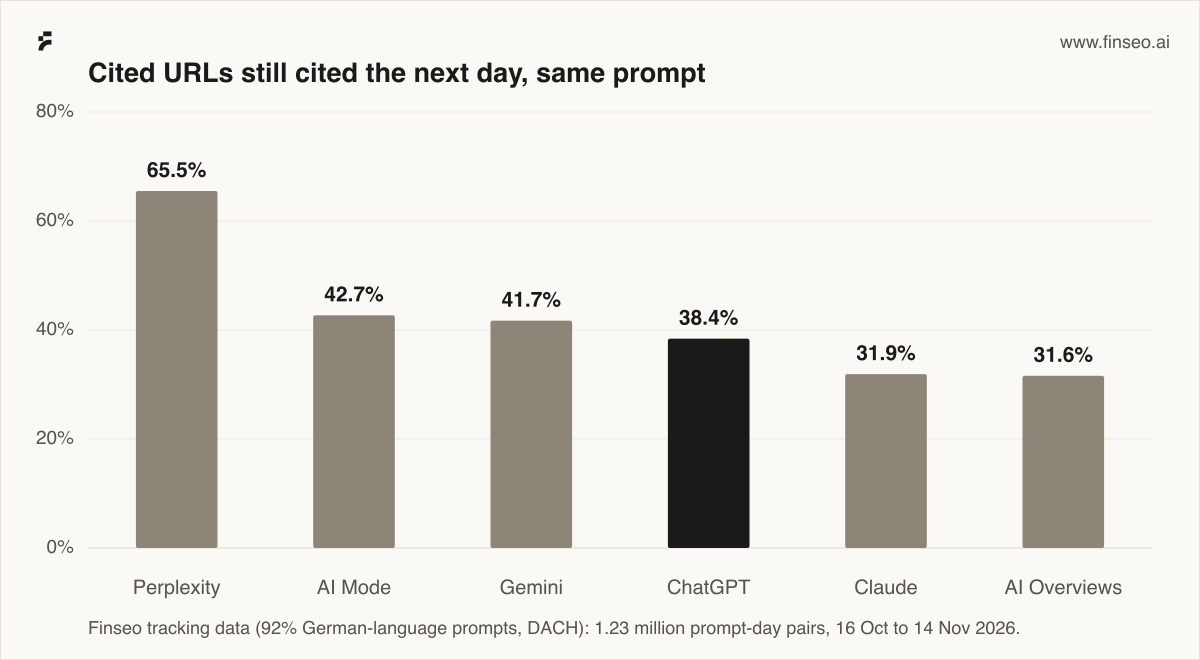
Run the same prompt on ChatGPT two days in a row and only 38.4% of the cited URLs come back the next day; on Perplexity it is 65.5%. The data is German-language AI search in Germany and the DACH region.
That matters to anyone who reads a single day of AI citations as a ranking. Across about 1.4 million answers to the same prompts, run daily on six engines, with about 92% of the prompts tracked for Germany, Austria and Switzerland (DACH), only about 3% to 8% of cited URLs were still cited on all seven following days on ChatGPT, Gemini and Google AI Overviews, and 12% on Perplexity, and on ChatGPT a single day's visibility reading missed the following fortnight by 16 points on average.
The same prompt cites different pages every day
Finseo runs every tracked prompt once a day on each engine a customer selects. That gives a clean test of stability: same prompt, same engine, consecutive days, and nothing changed on our side. Across 30 days, from 16 October to 14 November 2026:
| Engine | Prompt-day pairs | Cited URLs kept next day | URL overlap (Jaccard) | Cited domains kept next day | Domain overlap (Jaccard) |
|---|---|---|---|---|---|
| EnginePerplexity | Prompt-day pairs199,408 | Cited URLs kept next day65.5% | URL overlap (Jaccard)53.4% | Cited domains kept next day72.7% | Domain overlap (Jaccard)60.9% |
| EngineGoogle AI Mode | Prompt-day pairs64,719 | Cited URLs kept next day42.7% | URL overlap (Jaccard)31.3% | Cited domains kept next day50.3% | Domain overlap (Jaccard)37.7% |
| EngineGemini | Prompt-day pairs128,164 | Cited URLs kept next day41.7% | URL overlap (Jaccard)28.6% | Cited domains kept next day48.8% | Domain overlap (Jaccard)34.4% |
| EngineChatGPT | Prompt-day pairs436,839 | Cited URLs kept next day38.4% | URL overlap (Jaccard)25.9% | Cited domains kept next day50.5% | Domain overlap (Jaccard)36.4% |
| EngineClaude | Prompt-day pairs6,781 | Cited URLs kept next day31.9% | URL overlap (Jaccard)23.1% | Cited domains kept next day41.1% | Domain overlap (Jaccard)31.0% |
| EngineGoogle AI Overviews | Prompt-day pairs393,229 | Cited URLs kept next day31.6% | URL overlap (Jaccard)21.6% | Cited domains kept next day40.1% | Domain overlap (Jaccard)27.9% |
Base: 1,229,140 prompt-day pairs, 16 October to 14 November 2026. Microsoft Copilot is tracked too, but nearly half of its answers come from a single account, so it is left out of every table in this study.
"Kept next day" is the share of yesterday's cited URLs that appear again today, computed per prompt and then averaged. Jaccard divides the URLs both days share by all URLs either day cited, so it also punishes new arrivals. Both count only pairs where the engine cited at least one source on both days.
An identical citation list two days running is rare. It happened on 1.7% of ChatGPT pairs, 4.1% for AI Overviews and 10.4% for AI Mode, the most repetitive of the six. For anyone doing AI citation tracking, the unit that holds still is the publisher, not the page: domain overlap runs 6 to 12 points above URL overlap on every engine, so engines often return to the same site through a different article.
Part of that churn is built into the models. Atil et al. (2024) ran five LLMs configured to be deterministic ten times on eight tasks and saw "accuracy variations up to 15% across naturally occurring runs", with up to 70% between the best and the worst possible run. Engines with web search add fresh retrieval on top of that.
After a week, almost nothing is still cited every day
Next-day overlap understates the churn, because a URL can drop out and come back. We followed every URL cited on a base day and asked two questions: is it cited again on exactly day 7 and day 30, and was it cited on every single day in between?
| Engine | Cited again on day 1 | Cited again on day 7 | Cited again on day 30 | Cited every day for 7 days | Cited every day for 30 days |
|---|---|---|---|---|---|
| EngineGemini | Cited again on day 138.7% | Cited again on day 736.0% | Cited again on day 3034.7% | Cited every day for 7 days7.8% | Cited every day for 30 days1.2% |
| EnginePerplexity | Cited again on day 141.1% | Cited again on day 733.6% | Cited again on day 3022.8% | Cited every day for 7 days12.0% | Cited every day for 30 days3.0% |
| EngineChatGPT | Cited again on day 129.4% | Cited again on day 727.5% | Cited again on day 3019.8% | Cited every day for 7 days5.6% | Cited every day for 30 days1.2% |
| EngineGoogle AI Overviews | Cited again on day 130.0% | Cited again on day 724.0% | Cited again on day 3016.7% | Cited every day for 7 days2.5% | Cited every day for 30 days0.3% |
Base days are 30 September to 15 October 2026, so every 30 day follow-up still falls inside the data. Shares are pooled over all base-day citations: about 187,000 for Gemini, 966,000 for ChatGPT, 1.0 million for Perplexity and 1.2 million for Google AI Overviews. Google AI Mode and Claude are missing from this table because in those earlier weeks a single account supplied more than a quarter of their base citations in at least one column.
Two patterns stand out. First, a citation that is gone tomorrow is not gone for good. About half of the URLs that dropped out the next day, between 53.0% and 56.6% on the four engines in the table (base days 15 October to 6 November 2026), were cited again within the following seven days. Second, Gemini behaves differently from the rest. Its day 30 rate, 34.7%, is barely below its day 1 rate, 38.7%, which points to a stable core of sources plus a rotating tail. ChatGPT and AI Overviews lose a third to a half of their day 1 share by day 30.
The strict test is brutal everywhere. Across the four engines, between 0.3% and 3.0% of URLs were cited on every one of 30 consecutive daily runs.
First-position citations hold on longer
Every answer lists its sources in an order, and the first source is the most prominent. We split each answer's citations into the first, the second and third, and everything after, then checked which of them came back the next day.
| Engine | First citation kept next day | Second and third kept | Fourth and later kept | Same first citation next day |
|---|---|---|---|---|
| EnginePerplexity | First citation kept next day76.5% | Second and third kept72.6% | Fourth and later kept61.3% | Same first citation next day46.4% |
| EngineGemini | First citation kept next day57.4% | Second and third kept51.2% | Fourth and later kept31.0% | Same first citation next day32.1% |
| EngineChatGPT | First citation kept next day52.9% | Second and third kept38.5% | Fourth and later kept30.1% | Same first citation next day30.7% |
| EngineGoogle AI Mode | First citation kept next day50.4% | Second and third kept38.6% | Fourth and later kept38.6% | Same first citation next day30.1% |
| EngineGoogle AI Overviews | First citation kept next day39.4% | Second and third kept32.3% | Fourth and later kept25.9% | Same first citation next day18.8% |
Base: 1,186,696 prompt-day pairs on these five engines, 16 October to 13 November 2026.
On every engine, the first citation is the most likely to survive, and on ChatGPT and Gemini it survives far more often than the tail. In the earlier 30 day window the first citation also led on each of the four engines with a sufficient base (Perplexity, Gemini, ChatGPT and Google AI Overviews). Even so, the top slot itself is not stable: the same URL led the list on two consecutive days only 18.8% of the time on AI Overviews and 30.7% on ChatGPT. A first position is a better bet, not a reservation.
A citation that survives is also not automatically one that supports the answer. Auditing four generative search engines, Liu, Zhang and Liang (2023) found that "only 74.5% of citations support their associated sentence", and that 51.5% of generated sentences were fully supported by their citations.
The brands an answer names change almost every day
Citations are a publisher's question. The brand question is which companies the answer names. Each answer's named brands are extracted, and we compared the set of names between consecutive days for the same prompt and engine.
| Engine | Prompt-day pairs analysed | Brand set changed overnight | Brand overlap (Jaccard) | Tracked brand flipped between named and not named |
|---|---|---|---|---|
| EnginePerplexity | Prompt-day pairs analysed199,502 | Brand set changed overnight91.1% | Brand overlap (Jaccard)37.3% | Tracked brand flipped between named and not named8.3% |
| EngineChatGPT | Prompt-day pairs analysed456,659 | Brand set changed overnight94.0% | Brand overlap (Jaccard)31.7% | Tracked brand flipped between named and not named10.9% |
| EngineGemini | Prompt-day pairs analysed202,777 | Brand set changed overnight93.0% | Brand overlap (Jaccard)30.5% | Tracked brand flipped between named and not named12.9% |
| EngineClaude | Prompt-day pairs analysed30,794 | Brand set changed overnight90.3% | Brand overlap (Jaccard)26.9% | Tracked brand flipped between named and not named8.9% |
| EngineGoogle AI Mode | Prompt-day pairs analysed69,726 | Brand set changed overnight93.7% | Brand overlap (Jaccard)23.5% | Tracked brand flipped between named and not named14.9% |
| EngineGoogle AI Overviews | Prompt-day pairs analysed437,242 | Brand set changed overnight94.5% | Brand overlap (Jaccard)22.4% | Tracked brand flipped between named and not named12.5% |
Base: 1,396,700 prompt-day pairs, 16 October to 14 November 2026; the change and overlap columns count the pairs in which at least one brand was named.
Where at least one brand was named, the full set of names was identical on consecutive days in only 5.5% to 9.7% of pairs. That figure is an upper bound on real churn, because a brand spelled two ways counts as two names.
The more useful line is the last column. For one specific brand, the one being tracked, the answer switched between naming it and not naming it on 8.3% to 14.9% of consecutive days. The list around a brand reshuffles constantly; whether that one brand is in it changes less often, but still often enough to make a single day unreliable.
How many daily runs a stable visibility estimate needs
Visibility here means the tracked brand was named in the answer or its own domain was cited. To see how much data a stable reading needs, we used a split-half test. For every prompt with a full 30 days, we took the first 1, 3, 7 or 14 daily runs from days 1 to 15 and compared that estimate with the prompt's actual rate over days 16 to 30.
| Runs used | ChatGPT, one prompt | ChatGPT, prompt set | AI Overviews, prompt set | Gemini, prompt set |
|---|---|---|---|---|
| Runs used1 day | ChatGPT, one prompt16.2 pts | ChatGPT, prompt set6.2 pts | AI Overviews, prompt set5.1 pts | Gemini, prompt set3.9 pts |
| Runs used3 days | ChatGPT, one prompt12.5 pts | ChatGPT, prompt set5.3 pts | AI Overviews, prompt set4.0 pts | Gemini, prompt set3.3 pts |
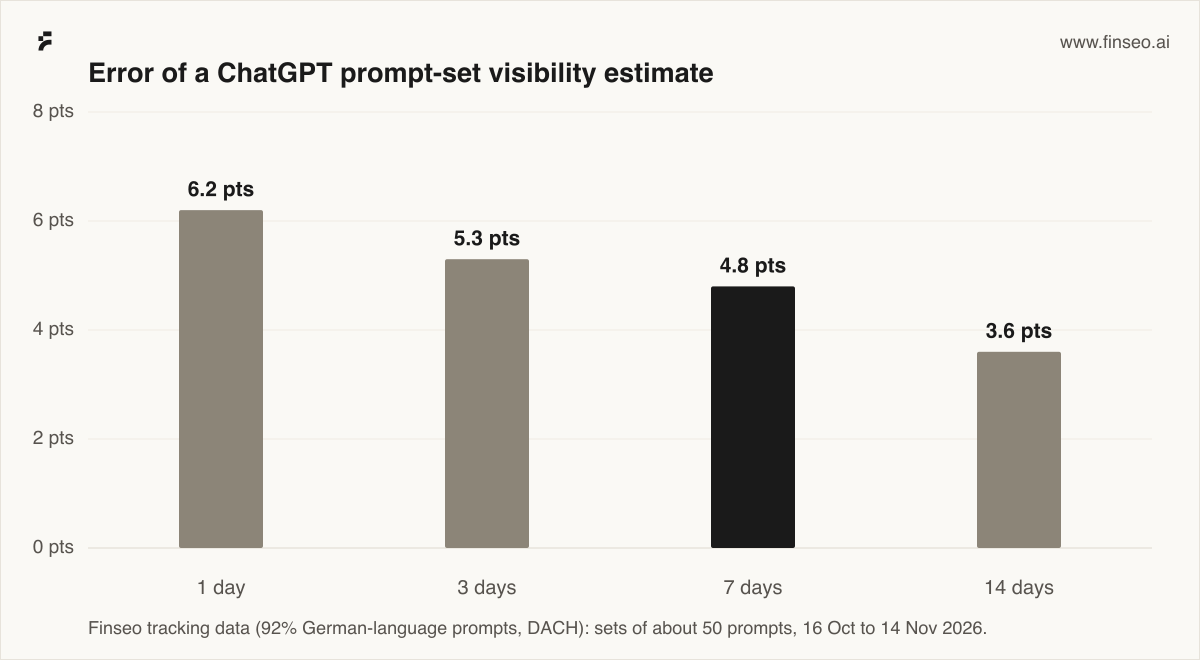
| Runs used7 days | ChatGPT, one prompt10.4 pts | ChatGPT, prompt set4.8 pts | AI Overviews, prompt set3.5 pts | Gemini, prompt set3.1 pts |
| Runs used14 days | ChatGPT, one prompt8.3 pts | ChatGPT, prompt set3.6 pts | AI Overviews, prompt set2.4 pts | Gemini, prompt set2.8 pts |
Each cell is the mean absolute error in percentage points. A prompt set is all of one tracked brand's prompts on one engine, with a median of 50 prompts (65 on Gemini). Base: prompts with a full 30 days of daily runs, 16 October to 14 November 2026: 12,790 on ChatGPT, 12,168 on Google AI Overviews and 5,190 on Gemini. Google AI Mode is left out here because one account supplies more than a quarter of its eligible prompts.
Three things follow. A single prompt cannot be read from a short window: even 14 daily runs missed the next fortnight by 8.3 points on ChatGPT, and landed within 10 points only 73.5% of the time. Averaging across prompts is what makes a number usable: a 50 prompt set measured for 7 days came within 5 points of the next fortnight 66.7% of the time on ChatGPT and 80.3% on AI Overviews. And daily runs are close to independent draws. On ChatGPT the brand flipped in or out on 12.7% of consecutive days, against 13.8% if every day were a fresh coin toss at the prompt's own rate.
That last point gives a usable rule. If runs behave like independent draws, the 95% margin of a visibility rate is about 1.96 × √(p × (1 − p) ÷ answers). At a typical rate of about one in three, about 350 answers per reported number gives a margin near ±5 points, which is 50 prompts for one week. A single prompt at the same rate needs about 86 runs for ±10 points, nearly three months of daily tracking.
Perplexity is the exception: its prompt-set error stayed near 7 points whatever the number of days (6,106 prompts). Its day-level swings move all prompts at once, so adding prompts does not cancel them.
How our figures compare with published research
Our data shows next-day URL retention between 31.6% (Google AI Overviews) and 65.5% (Perplexity) when both days carry citations, with about half of the lost citations returning within a single week. How a study counts decides most of what it reports: an intersection across three runs always comes out lower than a two-day comparison, and counting answers that cite nothing makes an engine look less stable. The repeatability framework by Shyr and colleagues, tested on 912,000 generations with 100 independent runs per medical case and model, adds a caution that applies here too: "an LLM producing a correct answer is not equivalent to producing it consistently."
What follows for measurement
Never report a single day. With 31.6% to 65.5% of yesterday's citations returning, one day is a sample, not a state. Report weekly rates in your AI visibility reporting and show the movement against the previous week, not the previous day.
Report prompt sets, not prompts. A single prompt needs about three months of daily runs for a ±10 point reading. Fifty prompts over a week get close to ±5 points. That is a strong argument for prompt research for AI search that builds topic sets wide enough to average.
Track domains alongside URLs. Domains are 6 to 12 points more stable than pages, so a page swap at the same publisher is not a loss.
Read each engine on its own scale. A 40% next-day overlap is normal for ChatGPT visibility tracking and alarming for Perplexity visibility tracking. The two Google surfaces also differ from each other, as we showed in AI Mode vs AI Overviews, and part of the daily churn comes from the sub-queries engines generate before answering, covered in query fan-out analysis.
Method note
Data, scope and reporting rules. The figures come from Finseo's own tracking data: the answers AI engines gave to the prompts our customers track, aggregated across several hundred customer projects. This article is one of three studies drawn from that data; citation stability and query fan-out cover 16 October to 14 November 2026, the most-cited domains 18 October to 14 November 2026 (UTC days, ending the day before the analysis). Before counting we removed every account that belongs to Finseo, its team or its founders' other companies, all admin, test, demo and pilot accounts, and every pitch or demo project in any account, together with archived and deleted prompts. Every reported cell rests on at least 10 customer accounts, and no figure is reported where a single account supplies more than 25% of the underlying answers or prompts; engines, markets and domains that miss this base are left out, and the text says so. Between 92% and 93% of the answers come from prompts tracked for Germany, Austria and Switzerland, so the results describe German-language AI search in Germany and the DACH region, not AI search worldwide. Prompts are chosen by customers and phrased commercially, so the corpus is large but not a random sample of searches. No customer, no customer's brand, no prompt and no answer is shown.
Window and sample. The primary window runs from 16 October to 14 November 2026: about 1.43 million successful answers to about 20,400 prompts. Retention uses base days from 30 September to 15 October 2026. Failed runs, deleted answers and prompts tracked weekly rather than daily are not counted.
Engines. ChatGPT, Google AI Overviews, Perplexity, Gemini, Google AI Mode and Claude. Claude rests on the smallest base of the six, so read its figures as less settled. Microsoft Copilot was left out of every table and chart: too few accounts track it, and a single account supplies close to half of its answers. Google AI Mode and Claude are reported only in the tables where they meet the base.
Metrics. Each prompt runs once per engine per day. URLs are compared after removing the scheme, "www.", query strings, fragments and trailing slashes. Overlap and next-day retention are computed per prompt-day pair and averaged; day 7 and day 30 retention are pooled over citations. Citation rank is the order in the answer's own source list. Visibility means the tracked brand was named or its domain cited.
Checks. Every headline figure was computed twice. An independent second calculation, which does not merge variants of the same URL, matched the next-day overlap within 0.5 points for ChatGPT, Perplexity, Gemini and Claude; for the two Google surfaces it came out about 3.5 points lower, because Google's citation URLs often differ only in their parameters. The same analysis on the previous 30 days (15 September to 14 October 2026) matched for Gemini within about 2 points. It did not match everywhere: ChatGPT grew steadily more stable through October (URL overlap 20.5% before, 25.9% now); AI Overviews dropped from about 49% to about 21% overlap within about ten days in late September, on the same prompts, for reasons we cannot see in the data; and Perplexity's citations per answer halved on 27 September and its day-level overlap swings widely. Read Perplexity as less settled than the rest.
Biases. The prompts lean toward commercial and comparison phrasing. Brand names are counted as extracted per answer, so spelling variants inflate brand churn. The repeatability framework we cite is a preprint.
FAQ
How stable are AI citations from one day to the next? Not very. On the same prompt and engine, 31.6% (Google AI Overviews) to 65.5% (Perplexity) of yesterday's cited URLs were cited again today. ChatGPT kept 38.4%, Google AI Overviews 31.6% and AI Mode 42.7%.
Which AI engine has the most stable citations? Perplexity, with 53.4% day-over-day URL overlap and 65.5% of URLs kept the next day. Google AI Overviews and Claude were the least stable.
How long does a citation in ChatGPT or AI Overviews last? Rarely long. 5.6% of ChatGPT citations and 2.5% of AI Overviews citations were present on every one of the next 7 daily runs. After 30 days, 19.8% and 16.7% were cited again on that exact day.
Are top-position citations more stable? Yes. The first citation is the most likely to return the next day on every engine, for example 52.9% against 30.1% for fourth and later on ChatGPT. The same URL keeps the first slot only 18.8% to 46.4% of the time.
Why do AI answers change every day for the same prompt? The models sample their answers, and engines with web search run fresh retrieval and fresh sub-queries each time. Even with nothing changed on the publisher side, the cited set and the named brands shift.
How many times should I run a prompt to measure AI visibility? For one prompt, about 86 runs give a ±10 point reading at a typical visibility rate of one in three. For a reported number, aim for about 350 answers: for example 50 prompts tracked daily for a week.
Does daily tracking still make sense if answers are this volatile? Yes, as a sampling method. Daily runs behave almost like independent draws, so each day adds information. The mistake is reporting each day as a result rather than averaging them.
Sources
Ours
- Finseo tracking data (about 92% German-language prompts, DACH): about 1.43 million answers, 1.23 million prompt-day pairs with citations, six engines, 16 October to 14 November 2026
- Finseo tracking data: citation retention at 1, 7 and 30 days, base days 30 September to 15 October 2026
- Finseo tracking data: split-half visibility estimates, prompts with 30 days of daily runs
External
- Shyr et al. (medRxiv, 2025), A statistical framework for evaluating the repeatability and reproducibility of large language models: https://pmc.ncbi.nlm.nih.gov/articles/PMC12637745/
- Atil et al. (arXiv, 2024), Non-Determinism of "Deterministic" LLM Settings: https://arxiv.org/abs/2408.04667
- Liu, Zhang and Liang (arXiv, 2023), Evaluating Verifiability in Generative Search Engines: https://arxiv.org/abs/2304.09848
Google Search
Save Finseo as a preferred source to see our articles more often in Top Stories, AI Overviews and AI Mode.